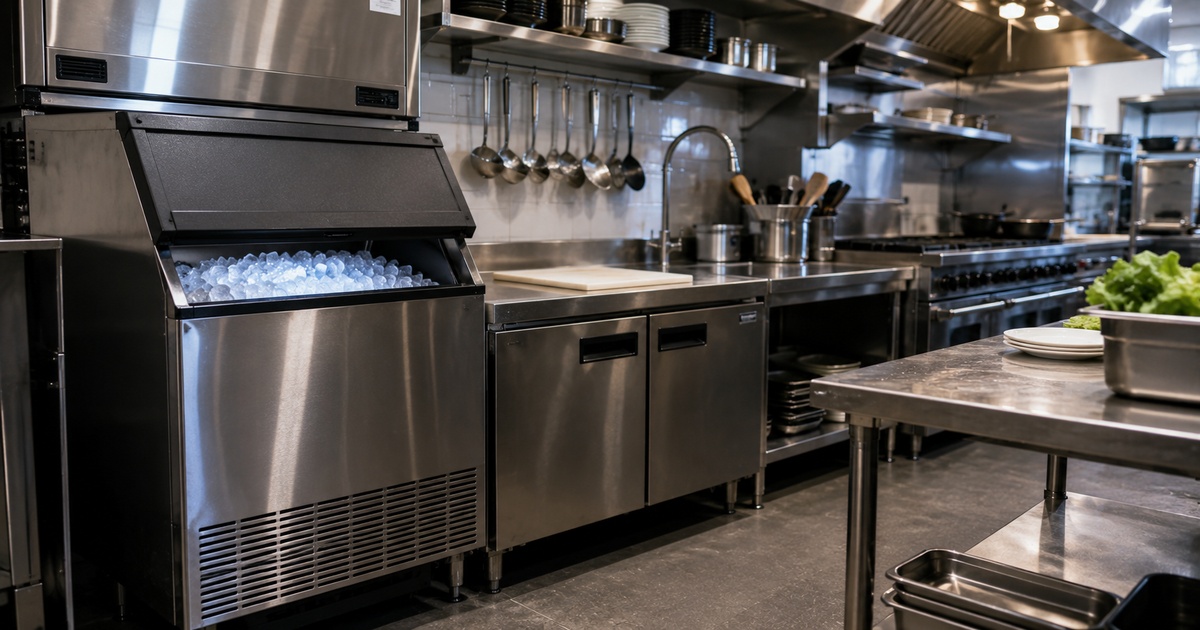
It is 6:42 p.m. on a Friday in March. The Fifth Avenue South dining room is packed, there is a 90-minute wait at the door, and a server walks back to the kitchen to tell the chef the Hoshizaki just stopped dropping ice. By 7:15 the bar is rationing cubes. By 8:30 the GM is on the phone calling every supplier in Collier County looking for a 20-lb bag. The next morning, the chef adds up what that dinner service cost — comped drinks, walked tables, a soft-comp to a regular four-top — and the number is north of $4,000. From an ice machine that needed a $185 inlet valve.
This is what commercial appliance failure looks like in Naples, and it is why same-day commercial service is not a luxury — it is the core of the contract. Here is how AllFix approaches commercial kitchens differently from residential, and what restaurant, cafe and catering operators should know before the next failure.
Commercial vs Residential Repair — They Are Different Trades
A residential tech who occasionally services a commercial unit will get most of it right. But there are real differences that show up the moment something complicated breaks:
- Compressors. Commercial units run 24/7 at much higher duty cycles. The compressors are larger, often scroll or semi-hermetic instead of reciprocating, and a wrong replacement charge can destroy the unit in days.
- Refrigerant. Residential is almost all R-410A or R-600a now. Commercial still runs R-404A, R-448A, R-449A, R-290 and even some legacy R-22 retrofits. EPA Section 608 certification covers all of it but the diagnostics differ.
- Electrical. Commercial often runs 208/230V single-phase or 208V three-phase. Misdiagnose a contactor on three-phase and you can take down a whole walk-in compartment.
- Warranty work. Most commercial brands require factory-authorized techs for warranty claims. Hoshizaki, Manitowoc, Traulsen and True all have specific certification requirements.
We staff and train specifically for this. When a Fifth Avenue restaurant calls about a Traulsen reach-in, the tech dispatched has worked on Traulsens before — that morning, probably.
What Naples Restaurants, Cafes and Caterers Actually Need
Most residential repair shops keep standard business hours, and customers can usually wait a day. Commercial does not have that luxury. A working commercial program looks like this:
- Same-day response during operating hours
- After-hours and weekend availability because that is when restaurants are open
- Holiday coverage — Easter brunch, Mother's Day, season openings
- Stocked truck inventory for common commercial parts — inlet valves, contactors, condenser fans, gaskets, compressors for the most common units
- Direct lines to commercial parts distributors in Tampa and Miami for overnight on rare items
We run our commercial program with all of the above. The seasonal nature of Naples — where revenue triples between November and April — means that downtime in February costs three times what downtime in August costs. The service contract has to reflect that.
Common Commercial Failures We See
From hundreds of commercial calls a year across Naples, Bonita Springs and Fort Myers, the failure list is short and predictable.
Walk-In Cooler and Freezer Compressors
The big one. A walk-in freezer compressor failure during season can spoil $3,000 to $8,000 in inventory before anyone notices. Telltale signs: condenser fan running but evaporator fan stopped, frost on the suction line, ambient temp climbing past 38F in a cooler. Most failures are contactor or capacitor — $150 to $300 repairs — not the compressor itself.
Commercial Ice Machine Slime and Scaling
Commercial ice machines should be deep-cleaned every 6 months — quarterly during heavy season. Skip it and you get pink slime (a Serratia bacteria) growing in the distribution tube, scale on the evaporator plate, and a unit producing 40% of rated capacity. This is the #1 commercial ice machine issue we encounter and is almost entirely preventable. Same principles apply for residential ice machine maintenance but at twice the frequency.
Range and Oven Gas Valves
Commercial ranges from Vulcan, Garland, Wolf commercial and Southbend run gas valves that fail from grease infiltration. A range with two of six burners not lighting is usually a $75 to $180 valve per burner. The pilot thermocouples on standing-pilot ovens are even cheaper — $40 to $70.
Commercial Dishwasher Pumps and Heating Elements
Hobart, Jackson and CMA dishwashers fail in two predictable ways: drain pump (often blocked by a stray bone or a piece of broken china) and heating element (mineral scale from our hard water). Both are sub-$400 repairs in most cases, but if the unit is down at dinner service the cost of a day-of-call is justified ten times over.
Brand by Type — What Naples Restaurants Run
For anyone planning a buildout or replacement, here is the operating reality on the ground:
- Ice machines: Hoshizaki dominates Naples for a reason — the commercial KM-series is the gold standard. Manitowoc is a strong second. Scotsman and Ice-O-Matic round it out.
- Walk-ins: Most are built by local refrigeration contractors using Heatcraft, Bohn or Copeland condensing units. Service is by component, not brand.
- Reach-ins: True owns the market for prep tables and reach-ins. Traulsen is the premium option — heavier build, more expensive parts.
- Ranges: Vulcan, Garland, Wolf commercial, Southbend, Imperial — straightforward to service, parts widely available.
- Dishwashers: Hobart is the standard. Jackson and CMA are common at smaller operations.
- Crossover (high-end residential running in commercial settings): DCS, Viking, Wolf — common at private clubs and catering kitchens where residential brands are used at higher duty cycles
The Downtime Math
This is the conversation we have with every new commercial customer. A casual-dining Naples restaurant doing $35,000 in revenue on a Friday night — about average for season on Fifth Avenue or Mercato — loses roughly $2,900 per hour of dinner service downtime if a critical appliance fails. A high-end Naples restaurant at $80,000 a night is closer to $6,500 per hour.
Against that, a same-day service call is $185 to $325 depending on the time of day. A weekend or after-hours call adds maybe $150. The ROI on a fast commercial relationship is not close.
This is also why we tell every restaurant operator the same thing: set up the maintenance contract before season starts. Quarterly preventive on ice machines, walk-ins and dish machines costs less than one Friday-night failure.
How AllFix Handles Commercial Calls
When a commercial customer calls, the call routing is different. A line cook reporting a Hoshizaki down at 6 p.m. gets a tech dispatched, not a callback the next morning. We carry the common Hoshizaki, True, Traulsen and Manitowoc parts on the truck. For walk-ins, we have refrigerant in all common types and can do field charging on the spot. After-hours, weekend and holiday coverage is built into the program.
We service restaurants, cafes, bakeries, catering operations, private clubs, country clubs, hotels and bars across Naples, Marco Island, Bonita Springs, Estero, Fort Myers and Cape Coral. AllFix serves all of Southwest Florida and our commercial response is the side of the business we have invested the most in.
Call (239) 544-4666 to set up commercial service or a maintenance contract.
Continue Reading
- Residential Ice Machine Maintenance — Keep Your SWFL Ice Flowing — same principles, half the duty cycle
- Repair or Replace — How to Make the Right Decision — applies to commercial units too
- AllFix Is Now Serving Southwest Florida — What We Stand For — the commercial side of our business