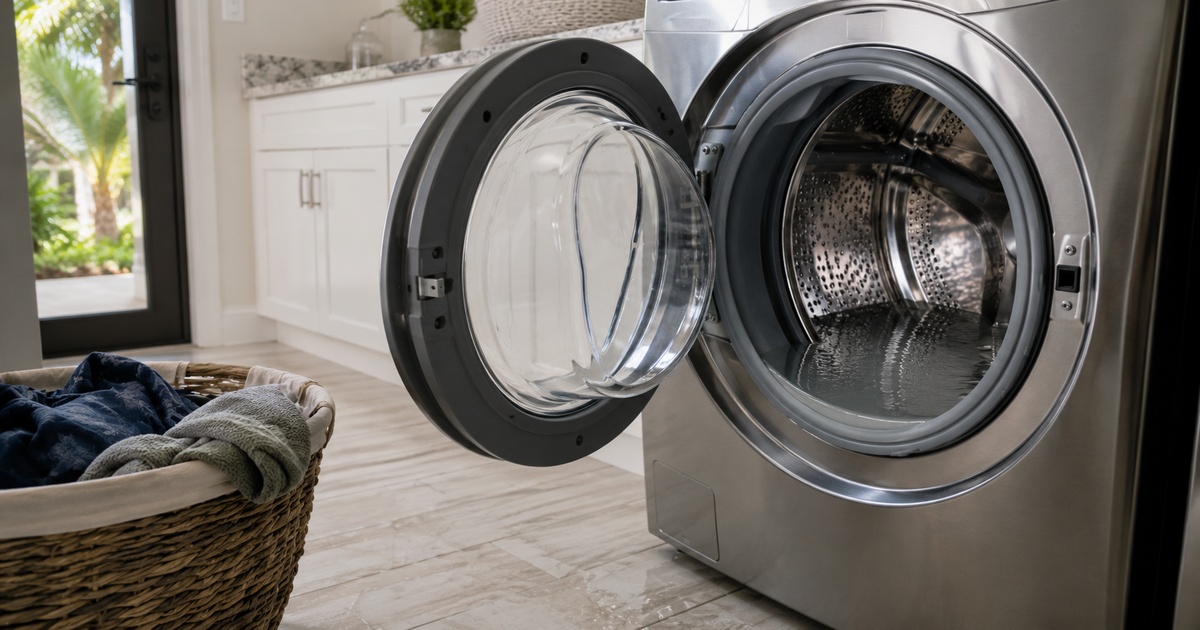
You opened the washer door this morning expecting clean clothes and instead got a tub full of gray water. Before you panic and book a service call, do these five checks. After almost two decades of running into Naples laundry rooms with the same problem, I can tell you that about 40% of "won't drain" calls turn out to be something the homeowner could have handled in fifteen minutes. The other 60% need a tech. This blog tells you how to figure out which side of that line you're on.
Grab a towel, a bucket, and a flathead screwdriver. That's the toolkit.
Step 1: Check the Drain Hose for Kinks (the 30-Second Fix)
This sounds too simple to mention, but it solves more drain problems than any other single cause. Pull the washer out four inches from the wall and look at the corrugated drain hose running from the back of the machine to the standpipe or laundry sink.
Is it bent at a sharp angle? Pinched between the machine and the wall? Looped too high (more than 96 inches off the floor)? Any of those and the pump can't push water up and out. Straighten it, give it a gentle U-curve over the standpipe, and run a drain-only cycle. If it drains, you just saved yourself a $189 service call.
Naples homes with stacked or pedestal washers are especially prone to this — every time the dryer vibrates, the hose creeps and folds. I'd estimate one in eight calls in Pelican Bay and Bonita Springs condos is a pinched hose, full stop.
Step 2: Clean the Coin Trap / Drain Filter (Most Owners Don't Know It Exists)
Nearly every front-load washer has a small access panel at the lower front, usually behind a kick plate. Behind that is a screw-out filter, sometimes called a coin trap or drain pump filter. It catches socks, coins, hair clips, bra wires, and lint before they reach the pump.
Here's the part nobody tells you: the manufacturer wants you to clean this every three months. Most people have never opened it. After six years in Naples humidity, that filter can look like something pulled out of a swamp.
How to do it safely
- Lay towels in front of the machine. There's always more water than you expect.
- Find the small drain tube near the filter cap and drain it into a shallow pan first.
- Unscrew the filter slowly (it threads counter-clockwise on most models).
- Pull out the debris, rinse the filter in the sink, screw it back in tight.
- Run a drain or rinse cycle.
On LG and Samsung front-loaders, the filter access is obvious and well-labeled. On Bosch, the access is the same location but the filter has a small lever-lock — turn the lever before unscrewing. On GE, Maytag, and Whirlpool top-loaders, this filter is generally not user-accessible; the lint is trapped internally and clearing it requires removing the pump.
Step 3: Reset the Cycle (the Bug Nobody Talks About)
Modern washers are computers, and computers freeze. If the control board misreads a sensor mid-cycle, the machine will sit in pause mode with water still in the tub. The fix is a power-cycle reset.
Unplug the washer from the wall for three full minutes. Not thirty seconds — three minutes. The control board has capacitors that hold a partial charge, and a quick unplug doesn't clear them. Plug it back in, select a drain or spin cycle only, and start it.
I see this most often on Samsung front-loaders from 2019-2023 and LG WM3900 and WM4000 series. They're great machines but they get into stuck states a couple times a year. Power-cycle clears it about 80% of the time.
Step 4: Listen to the Pump
With the tub still full of water, start a drain cycle and put your ear against the front-bottom of the machine. You should hear a low motor hum within ten seconds.
- You hear humming but no draining — the impeller is jammed by an object. Go to Step 5.
- You hear nothing at all — the pump motor is dead, or the control board isn't sending power. This is where most DIYers should stop.
- You hear a loud rattling buzz — pump bearings are failing. Time to call.
An odd appliance sound is almost always the first warning sign — washers are no exception. If the hum is steady and confident, the motor is fine; the path is just blocked.
Step 5: Check the Drain Pump for a Clogged Object
This is the last DIY step before you call. After you've cleared the filter and the pump is humming but not pushing water, there's almost certainly something lodged just past the filter — in the impeller chamber itself.
With the machine unplugged and the water bailed out via a bucket and the small drain tube, shine a flashlight into the filter housing. Reach in with a finger (gently — the impeller has plastic vanes) and feel for a hard object. The usual suspects: a sock toe, a coin, a baby sock, an underwire, sometimes a guitar pick.
Remove it, reinstall the filter, run a drain cycle. Done.
Speed Queen owners have an advantage here: the older mechanical-timer top-loaders (TC5, TR5) have a direct-drive pump that almost never jams. The electronic Speed Queens (FF7, FR7) have a separate pump filter accessible from below, but it's a tighter access than LG/Samsung.
When to Stop DIY and Call a Tech
These symptoms mean stop and call:
- Burning rubber or electrical smell — the pump motor is overheating or the wiring is shorting.
- Water dripping under the machine — internal hose or pump seal failure, not a drain issue.
- Error codes 5E, OE, F9E1, nd, or E18 — drain-system fault codes, all of which need diagnostic equipment.
- You hear the door lock click but the cycle won't start — that's the door switch or main control, not the drain.
- Tripped breaker or sparking — turn the breaker off and call. Don't go near it.
The service call in Naples for a no-drain diagnosis runs $129-$189, and the most common repair (pump replacement) is $280-$450 depending on model. Front-loaders are about $80 more than top-loaders because of the access work. If you've got a Speed Queen or Miele, parts are stocked and the repair is usually one visit. Bosch and Asko sometimes require an ordered part — 3-5 business days.
Brand-Specific Notes Worth Knowing
- LG WM-series: Filter is well-designed and worth cleaning quarterly. Drain pumps are reliable through year 8.
- Samsung WF-series: Same filter design as LG. The 2019-2021 models had a known control-board issue causing false drain faults — a reset fixes 70% of those.
- GE GTW and GFW: Internally trapped lint on top-loaders means most no-drain calls need a tech.
- Maytag/Whirlpool Cabrio and similar high-efficiency top-loaders: The bellows trap can collect coins; needs a tech to access.
- Speed Queen: Mechanical models almost never have drain problems; electronic models have a service-friendly pump.
- Bosch front-loaders (300, 500, 800 series): Filter location is the same as LG but the lever-lock design means slower DIY access. Very rarely the actual cause.
A Naples homeowner who keeps the lint trap clean, the drain hose straight, and resets the machine once a year will probably never need a drain repair. The machines are sturdier than people think — they just need ten minutes of attention twice a year.
And if you've worked through all five steps and the water is still sitting there, that's our cue. We'll bring the right pump and the right diagnostic tool, and we'll have your machine running before the next load.
Call AllFix When DIY Isn't Enough
If the five steps above didn't fix it — or you'd rather skip them entirely and have a tech handle it — we're a phone call away. We serve Naples, Marco Island, Bonita Springs, Estero, Fort Myers, and Cape Coral, and most washer drain calls are resolved in a single visit with parts on the truck.
Call (239) 544-4666 or book online at allfixappliancerepair.com. Same-week appointments standard, next-day available for most ZIP codes.
Continue Reading
- 5 Signs Your Refrigerator Needs Professional Repair — the early warnings most owners miss
- Repair or Replace: How to Make the Right Decision for Your Appliance — when a fix stops making sense
- Your Appliance Is Trying to Tell You Something: A Sound Guide — what those clicks, hums, and rattles actually mean