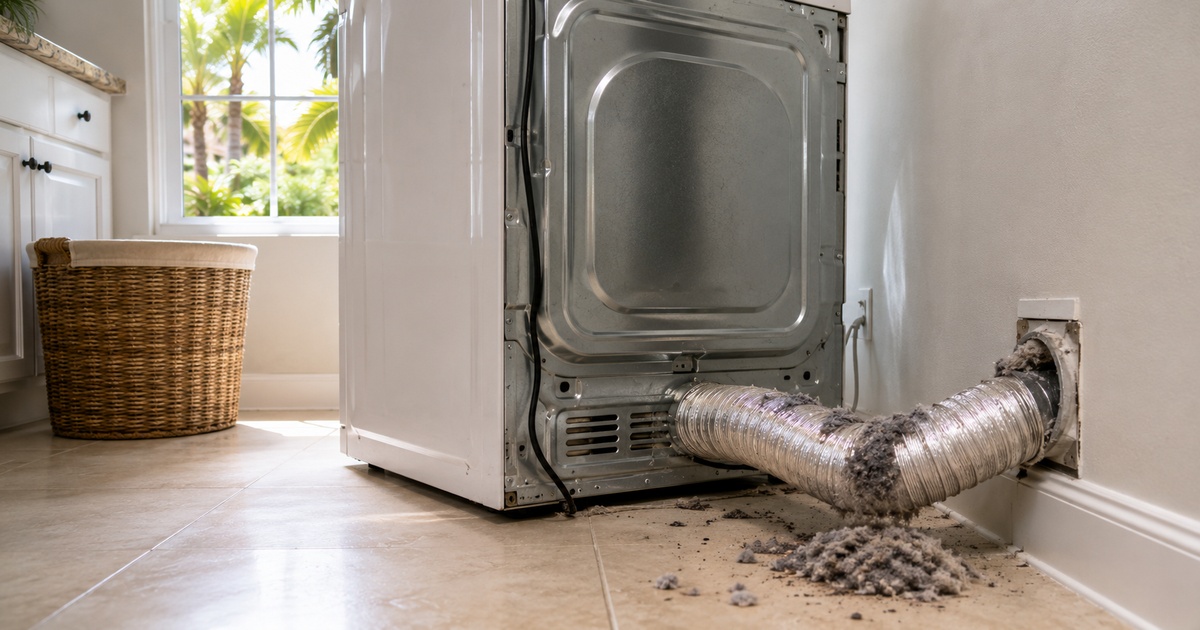
If your dryer is running two cycles to finish a single load of towels, it isn't broken. The vent is. That's the single most common dryer call I get in Naples, and it's almost never the machine itself — it's the four to twenty feet of ductwork between the dryer and the outdoor wall vent. The humidity here makes vents clog two to three times faster than dryers in drier climates, and most homeowners don't think to check it until the laundry routine doubles.
This is the diagnostic walkthrough I'd give my own neighbor.
The Math: What a Clogged Vent Actually Costs You
A dryer pulling a clean vent uses about 3.5-5 kWh per cycle. A dryer fighting a 70%-blocked vent — which is what most Naples homes have after three to four years without cleaning — uses 8-11 kWh per cycle. At Florida's roughly 16 cents per kWh, that's an extra $240-$340 per year in wasted electricity for a household running five loads a week.
Add the cost of replacing a dryer that died two years early from heat stress (a $1,100-$1,800 mid-range loss) and the math gets ugly. A $25 vent brush and an hour of work would have prevented all of it.
More on the cost side of appliances: appliances are often the hidden driver behind a surprising power bill.
The 5-Point Vent Diagnostic
Work through these in order. If you find a problem at any step, fix that first and re-test before moving to the next.
1. Lint Trap (the obvious one, but check it right)
Most people pull the screen out, peel off the visible lint, and slide it back in. That's only half the job. Hold the screen up to a light. If you can't see light through it clearly, fabric softener residue is sealing the mesh. Wash it in warm soapy water with a soft brush every six months.
2. Transition Hose (between dryer and wall)
This is the flexible duct connecting the back of the dryer to the wall opening. Pull the dryer out gently. If the hose is plastic or vinyl, replace it today — those are no longer code-compliant and they're a fire risk. You want rigid aluminum or semi-rigid foil duct. While you've got it disconnected, look inside for the lint plug; this is where about 30% of the blockage lives.
3. Full Vent Run
This is the duct from the wall behind your dryer to the exterior vent on the outside of the house. In Naples single-story homes, this run is usually 8-15 feet. In two-story homes and condos, it can run 25-40 feet, sometimes vertically through the roof.
Disconnect the dryer, run a vent brush kit through the wall opening (the $25 kit at Home Depot reaches about 12 feet; longer kits run $45-$60). Push and pull, rotating the brush. The amount of lint that comes out the other end will surprise you — I've pulled out softball-sized clumps from homes in Talis Park and Mediterra that were only five years old.
4. Exterior Vent Flap
Walk outside and find the dryer vent cap on the wall. Run the dryer on air-only or low heat. The flap should be fully open with strong airflow. If it's barely fluttering, or if the flap is stuck open from accumulated lint, that's your problem.
In coastal Naples and Marco Island homes, salt air corrodes the cheap aluminum flaps in about four years. Replace with a stainless-steel hooded vent ($35-$60). Also check for bird and lizard nests — anoles love these vents, and so do palm warblers in winter.
5. Roof Vent (if applicable)
Some homes in Pelican Bay and Park Shore vent through the roof rather than a side wall. These need a professional cleaner — they're 20+ feet of vertical run and the cap on the roof needs eyes-on inspection annually. Don't go up there yourself if you've never done it.
DIY Cleaning: What You Actually Need
The basic kit:
- Vent brush kit with extendable fiberglass rods ($25-$60)
- Vacuum with hose attachment
- Screwdriver (Phillips and flathead)
- Foil tape (never duct tape on a dryer vent — it fails in heat)
- New transition hose if yours is plastic ($15)
Unplug the dryer (or shut off gas if it's a gas dryer). Disconnect the transition hose. Brush the wall duct from inside, then go outside and brush from the exterior vent inward. Vacuum everything that falls out. Reconnect, seal with foil tape, push the dryer back, and run a 20-minute air-only cycle. You'll see lint puffs come out the exterior vent for the first few minutes — that's normal.
Time: 60-90 minutes. Frequency: every 12 months for a normal Naples household, every 8 months for households with pets or 4+ residents.
The Fire Hazard Nobody Talks About
The U.S. Fire Administration logs roughly 2,900 dryer fires per year nationally, with 34% caused by failure to clean the vent. Collier and Lee counties combined see well over 200 dryer-related fire calls annually, and that's only the ones serious enough to require response.
A fully clogged vent + a hot dryer + accumulated dry lint = a fire that starts behind the machine and is in the wall cavity before the smoke alarm sounds. The lint itself burns at 450°F, and a stressed heating element can reach 550°F.
The warning signs that you're closer than you think:
- Dryer feels unusually hot to the touch on top after a cycle
- Laundry room is humid or warm during/after running
- Clothes come out hot but still damp (heat can't escape, so moisture can't leave)
- A musty or burnt smell
- The dryer shuts off mid-cycle (high-limit thermostat tripped — a final safety)
If any of those describe your dryer, stop using it and call. This is not a wait-till-next-month item.
Brand Notes — Who Tells You the Problem Early
The newer generation of dryers has gotten smarter at detecting airflow issues:
- LG DLEX series (2020+) — shows a "Check Vent" icon when airflow drops. Reliable indicator.
- Samsung DVE series (2021+) — similar vent-blockage warning on the control panel.
- GE Profile with SmartDispense — the app sends a notification when cycle times start trending longer.
- Maytag Bravos and newer — sensor-based moisture detection that runs longer if airflow is low; no warning, just longer cycles.
- Whirlpool Cabrio and Duet — same as Maytag, no specific vent alert.
- Speed Queen DR series — built tougher and handles longer vent runs better than residential brands, but no smart warning either.
If you're running a dryer made before 2018, you're the alarm system. Pay attention to cycle times and laundry-room humidity.
When to Upgrade Instead of Repair
A dryer that's been running on a clogged vent for years is probably nearing end-of-life. Once you've cleaned the vent and the dryer still takes long cycles, check:
- Age over 10 years
- Heating element repair quoted over $400
- Drum bearings squealing (indicates bigger wear)
- Burning smell even with a clean vent
At that point, replacement makes more sense than repair. A good mid-range dryer (LG DLE7300WE, Samsung DVE45T6005V, or GE GTD42EASJWW) runs $750-$950 installed. Speed Queen DR5 is the longevity play at $1,400-$1,600 — built for 20+ years.
And of course, Naples humidity is a daily test for every appliance in the house, so building the routine of annual vent cleaning into your home maintenance — same week as your AC filter swap — is what makes a dryer last in Florida.
If you're already planning ahead, the hurricane prep checklist is the other piece worth bookmarking — June through November is when laundry routines spike and dryer issues compound fastest.
Call AllFix for Vent Cleaning or Dryer Repair
We handle both the dryer service and full vent cleaning in one visit — including roof vents and long condo runs. Naples, Marco Island, Bonita Springs, Estero, Fort Myers, and Cape Coral.
Call (239) 544-4666 or book online. Most jobs are done in 60-90 minutes; we bring the brush kit, foil tape, and a new transition hose so you don't have to source parts.
Continue Reading
- Why Florida Humidity Is Slowly Destroying Your Appliances — the silent enemy in every Naples home
- Why Your Energy Bill Is Higher Than Expected — appliances are the usual suspect
- Hurricane Appliance Prep Checklist — protect every appliance before the storm