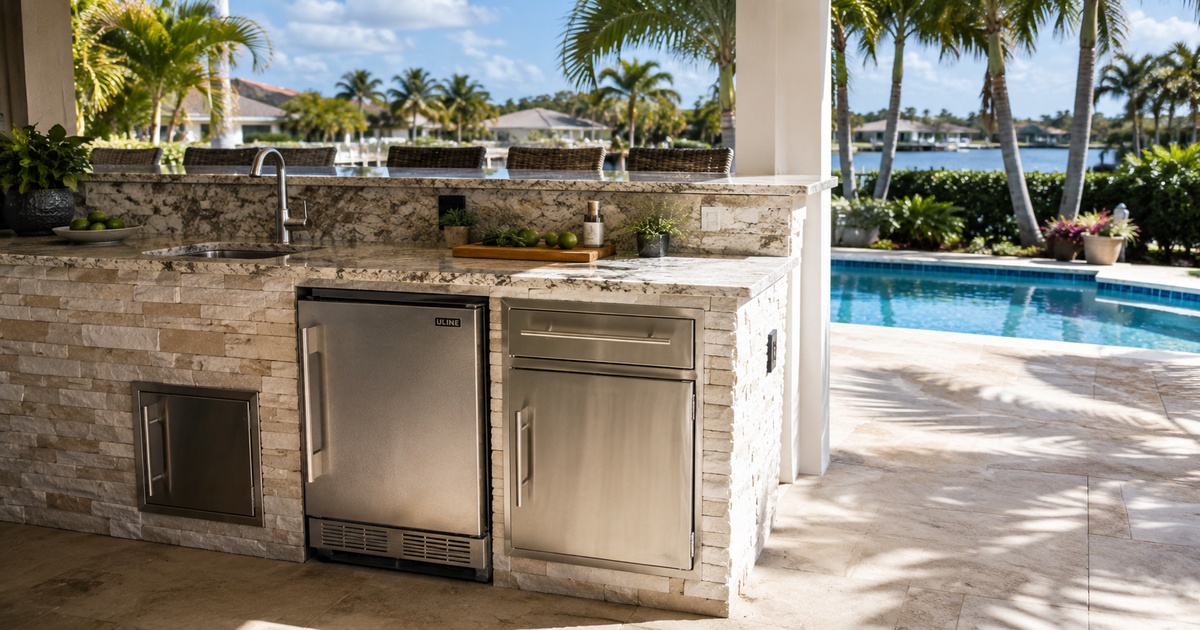
Walk through any Naples luxury home and you'll find at least two extra refrigerator outside the main kitchen. One in the pool house. One in the garage for overflow drinks and the deep freezer. Maybe a third on the lanai for beer and wine.
Those machines are dying fast. Faster than the homeowner realizes. We replace pool house and garage fridges in Port Royal, Quail West, and Mediterra every single week — and most of them are under 6 years old.
Here's why Florida is the most hostile environment in America for a refrigerator, and what actually keeps one alive.
The Three-Headed Florida Killer
A refrigerator works by pulling heat out of the food compartment and dumping it into the surrounding air. The hotter the surrounding air, the harder it works. Simple physics.
In a Naples garage in August, ambient temperature hits 100–115°F by 4 PM. That's not the outdoor temperature — that's the trapped-air-in-a-closed-garage temperature. A pool house with a 12-foot ceiling fan and an open louver vent might run 88–95°F.
Most indoor refrigerators are engineered to run in 55–85°F ambient. Above 90°F sustained, the compressor never gets to rest. It runs 80–90% of the day instead of the usual 30–40%.
That's killer number one: heat exposure that doubles compressor runtime.
Killer number two: humidity. Naples averages 75% relative humidity year-round, spiking into the 90s during summer afternoons. Humidity condenses on cold surfaces — the evaporator coils inside, the gasket, the door frame. Constant moisture corrodes electrical contacts and breeds mold on door seals. Read the deeper version in our Florida humidity guide.
Killer number three: salt air. If you're within three miles of the Gulf — Old Naples, Park Shore, Marco Island, anywhere on Gordon Drive — salt is in your air. It settles on condenser coils as a fine corrosive film. Salt on copper plus moisture equals pitting and pinhole refrigerant leaks. We see this on Marco Island pool houses constantly.
The 5-Year Survival Rate Data
We pull our own service data on this. Across 600+ outdoor and garage fridge service calls in Lee and Collier counties over the past four years:
- Indoor-rated fridge placed outdoors: average lifespan 4–6 years before major repair or replacement
- Indoor-rated fridge in air-conditioned garage: 8–10 years
- Outdoor-rated fridge in pool house or lanai: 10–14 years
- Same indoor-rated unit installed in the main kitchen: 12–15 years
That's a 40–60% lifespan hit just from the wrong placement. We tell clients in Talis Park and Grey Oaks the same thing every time they ask: if it doesn't say "outdoor-rated" on the spec sheet, it doesn't belong outside in Naples.
Why Indoor Brands Fail Outside
Indoor refrigerators have:
- Galvanized steel cabinets (rust in salt air within 18 months)
- Painted condenser coils rated for low-humidity environments
- Standard electronics with no humidity-sealed control boards
- Door gaskets rated for 35–80°F operating envelope
- Bottom-mount condensers that pull garage dust and salt right into the cooling system
Drop a Samsung, LG, or even a high-end Whirlpool built for the kitchen into a Naples pool house and you're starting a countdown. Compressor failures are the most common death — the unit simply can't keep up, runs continuously, and the compressor windings burn out.
We've also seen Sub-Zero built-ins moved out to lanais during remodels. Even Sub-Zero's standard indoor models — magnificent in a kitchen — degrade in 5–7 years if they're moved outside. The exception is their Outdoor Series, which is a completely different machine.
Brands That Are Actually Built for It
Three categories of refrigeration are engineered for Florida outdoor use:
True outdoor-rated
- U-Line Outdoor Series — purpose-built for outdoor kitchens, 304 stainless wrap, rated to 110°F ambient. Common in Naples lanais.
- Marvel Professional Outdoor — similar specs, slightly larger capacities.
- Perlick Signature Series Outdoor — premium tier, marine-grade construction, often spec'd in Port Royal outdoor kitchens.
- Sub-Zero Outdoor (PRO 36 Outdoor, 24" Outdoor Refrigerator Drawers) — top of the market. Built with humidity-sealed electronics and 110°F+ ambient rating.
Garage-ready (good for enclosed garages)
- GE Garage Ready series — pretty good for Naples garages that hit 100°F. About $1,400–$1,900.
- Frigidaire Garage Ready — similar capability, lower price point.
- Gladiator by Whirlpool — chest freezers and uprights rated for 0–110°F garages.
Not for outside, no matter what the salesperson says
Any standard kitchen refrigerator from LG, Samsung, KitchenAid, Bosch, Frigidaire (non-Garage-Ready), or Whirlpool. They will work for a year or two and then they will die. We know because we replace them.
The Maintenance Routine That Actually Helps
If you already have a fridge outside — outdoor-rated or not — here's the routine that adds years:
Monthly
- Vacuum the condenser coils (bottom front or back) with a soft brush attachment. Salt and dust insulate the coils and force the compressor to work harder.
- Wipe down the gasket with a damp cloth — no harsh cleaners. Check for tears or warping.
- Open the door and check for condensation on the inside top of the cabinet. Heavy condensation means the seal is failing.
Every 3 months
- Pull the unit away from the wall and clean the back coil, the floor underneath, and the wall behind. Pool house spiders and palmetto bugs love that warm spot.
- Wipe the exterior stainless with mineral oil if it's 304 stainless. Don't use abrasive pads — they break the protective oxide layer and accelerate salt corrosion.
Annually
- Have a tech check refrigerant pressures. A slow leak from salt corrosion will starve the system long before the compressor fails — catching it early is a $250 repair instead of a $1,400 replacement.
- Replace door gaskets if they show any cracking. Run-down gaskets force the compressor to overwork.
- Confirm the unit is plugged into a surge-protected outlet (we recommend a whole-house surge protector for Naples homes — see our hurricane prep guide).
Snowbird Special Protocol
If you're a snowbird and the home sits empty May through October, the pool house fridge has two options:
Option 1: Run it. Set it to 38°F, keep it mostly empty, leave a few sealed bottles for thermal mass. Have a property manager check it monthly. The compressor stays lubricated; the system stays pressurized.
Option 2: Shut it down right. Empty completely. Clean and dry the interior. Prop the door open with a wedge so it doesn't seal closed and grow mold. Unplug. This is the better choice if no one will be checking on the property.
Leaving a stocked fridge running unmonitored for five months is how we get the August call: "It smells like death in the pool house." By the time the compressor fails, the food has fermented and the gaskets are growing things you don't want to identify. The full version of this is in our snowbird checklist.
When It's Time to Upgrade
If your pool house or lanai fridge is over 6 years old and indoor-rated, you're on borrowed time. The upgrade to a proper U-Line, Marvel, or Sub-Zero Outdoor model runs $1,800–$4,500 depending on size, but you'll get 12+ years out of it instead of 4. Math works.
For garage refrigerators in a non-air-conditioned space, GE Garage Ready is the value play — about half the cost of an outdoor unit, and rated for the conditions a Florida garage actually delivers.
Call AllFix
We diagnose and repair outdoor and garage refrigerators across Naples, Marco Island, Bonita Springs, Estero, Fort Myers, Cape Coral, and Pelican Bay — and we install replacement outdoor refrigeration for Port Royal, Mediterra, Talis Park, Quail West, and Grey Oaks homes regularly. Call (239) 544-4666 or book online at allfixappliancerepair.com.
Continue Reading
- Why Florida Humidity Is Slowly Destroying Your Appliances — the science of the slow corrosion you can't see.
- Florida Homeowners: Why Humidity Is Your Appliances' Worst Enemy — the daily-habit fixes that work.
- Snowbird's Appliance Shutdown Checklist — what to do with that pool house fridge before you head north.