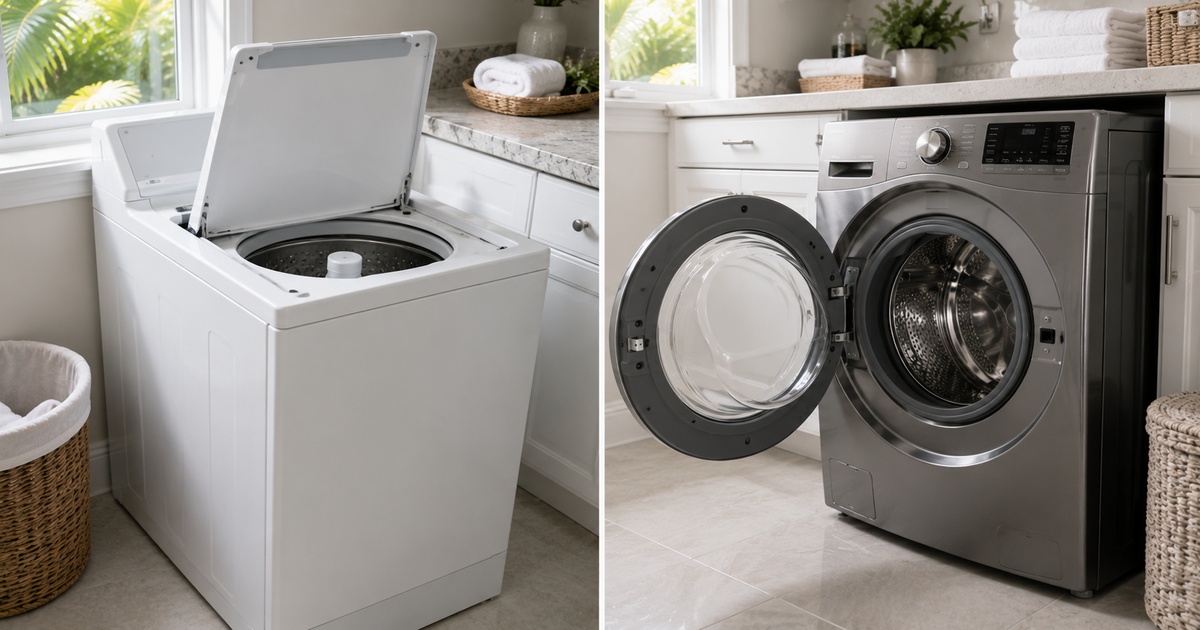
Top-load or front-load? The debate has gone on for twenty years. In most parts of the country it's a preference question. In Naples it's a humidity question — and the humidity changes the math more than most people realize before they buy.
After fixing thousands of both kinds of washer in Naples, Marco Island, Bonita Springs, and the surrounding area, here's the honest read.
Front-Load: What It Does Well
Front-loaders are the engineering darlings of the modern laundry world. The drum spins on a horizontal axis, tumbling clothes through a small pool of water rather than agitating them in a full tub.
Real advantages
- Water efficiency. Uses 13-18 gallons per load vs 25-40 for a top-loader. Over a year of normal use that's a real savings in Naples water bills.
- Gentler on clothes. No center agitator means less wear on fabrics. Cashmere, silk, and technical athletic wear last noticeably longer.
- Higher spin speeds. Premium front-loaders spin at 1,200-1,400 RPM. Clothes come out 30-40% drier, which means shorter dryer cycles.
- Larger capacity in same footprint. Without the agitator column, a 4.5 cu-ft front-loader holds about 25% more than a 4.5 cu-ft top-loader.
- Stackable. Big in Naples condos and second-floor laundry rooms.
Real disadvantages (in Florida)
- Mold and mildew. This is the one that matters here. More on this in a moment.
- More expensive upfront. A solid front-loader runs $1,100-$1,800 vs $700-$1,200 for an equivalent top-loader.
- More expensive to repair. Door seal (bellows) replacements run $300-$550. Drum bearings — when they fail at year 7-10 — can be a $700-$900 repair, often pushing owners to replace instead.
- Door has to be left ajar between uses. Otherwise mold starts.
- You can't add a forgotten sock mid-cycle. Once the door locks, you're committed.
Top-Load: What It Does Well
Top-loaders fall into two camps now: traditional agitator models (the center-post design that's been around forever) and high-efficiency (HE) impeller models that use a wash plate instead of an agitator.
Real advantages
- No mold problem. The lid stays open between uses, the tub air-dries, and the drum geometry doesn't trap water in a rubber gasket. This is the Naples winning feature.
- Lower purchase price. $700-$1,200 for most models; commercial-grade Speed Queen runs higher.
- Add forgotten items mid-cycle on most models.
- Simpler mechanical design (especially on traditional agitator models). Fewer electronic parts to fail.
- Better for heavy soil and large items like comforters and bedding (impeller HE models excepted).
Real disadvantages
- Uses more water. 25-40 gallons per load vs 13-18 for front-load.
- Harder on clothes due to the agitator action.
- Lower spin speed (about 700-1,000 RPM on most), so clothes come out wetter and dryer cycles run longer.
- No stacking option. Takes up dedicated floor space.
- HE impeller models have their own quirks — clothes can bunch unevenly and trigger unbalanced loads.
The Naples Humidity Reality (The Mold Question)
Here's the part I'm direct about because it matters: of the front-load washers I service in Naples that are more than three years old, roughly six in ten have visible mold or mildew around the door bellows, detergent drawer, or interior gasket.
This isn't bad luck. Naples averages 75-85% relative humidity for most of the year. A front-loader has a rubber door bellows that traps a small amount of water after every cycle. In a dry climate, that water evaporates. In Naples, it sits there, warm and dark, growing biofilm.
The symptoms appear gradually:
- Slight musty smell from the door, especially first thing in the morning
- Black or pink spots on the rubber bellows
- Clothes coming out with a faintly off scent even after a clean cycle
- Detergent drawer staining
Most of the time, this is preventable with:
- Door left ajar between uses (always)
- Detergent drawer removed and rinsed weekly
- A tub-clean or sanitize cycle once a month
- Wiping the bellows dry after each load (the part nobody does)
But realistically? Most owners won't keep up with that. After three or four years, the mold has worked its way past where wiping can reach.
This is the same humidity story that quietly destroys appliances all over Naples — and washers are one of the more visible casualties.
Brand Picks That Actually Matter
Top-Load Champions
- Speed Queen TR7 and TC5 — commercial-grade machines built for residential. The TR7 is the closest thing to a tank in the residential market. 25-year build expectation. Expensive ($1,400-$1,800) but unmatched longevity.
- Maytag MVW7232 — solid HE top-loader, reasonable price, decent reliability.
- GE GTW720 — best mid-range option, good service network.
- Whirlpool WTW8127 — comparable to Maytag (same parent company), slightly different controls.
Speed Queen is the one I tell snowbirds and second-home owners about specifically. If you're leaving a property unattended for five to seven months, you want a machine that doesn't need babysitting — and Speed Queen is the answer.
Front-Load Champions
- LG WM4000 and WM6500 — best mainstream front-loader. Direct-drive motor (no belt to fail), excellent spin speeds, smart features actually useful.
- Samsung WF45 and WF50 — comparable to LG, slightly better aesthetics, slightly more electronic complexity.
- Bosch WAT and Axxis series — European compact units. Great for condos, very water-efficient, more expensive parts.
- Asko W6000 series — Swedish-built, premium, used in many high-end Naples remodels. Sealed bearing system that holds up better than American front-loaders in long-term use.
- Miele W1 series — the absolute top. $2,500-$3,500. Built for 20-25 years.
If you're going front-load in Naples, the European brands (Asko, Miele, Bosch) tend to hold up better against humidity because their door seal geometry drains more completely. Not perfect, but better.
A quick reminder — front-loaders also have a separate drain-clogging risk you should know about. The 5-step drain DIY guide covers it.
Recommendation Matrix
Snowbird home, 5-7 month vacancy
Top-load winner. Specifically Speed Queen TR7 or Maytag MVW7232. Door stays open during vacancy, humidity doesn't build up inside a sealed bellows, you come back to a fresh-smelling washer in November.
Year-round family, 3+ kids, heavy laundry
Front-load winner. Bigger capacity matters more than mold risk if you're actively using and maintaining the machine. LG WM6500 or Samsung WF50. Strict habit of leaving the door open between uses.
Year-round couple, normal use
Either works. Lean front-load if water efficiency and gentler-on-clothes matter to you. Lean top-load if low-maintenance is the priority. The mold risk is manageable with discipline; the question is whether you have the discipline.
Luxury home, premium build
Asko or Miele front-load with steam. The build quality justifies the cost. Pair with a matching dryer. These machines look right next to a Sub-Zero and a Wolf range.
Condo, small space, stackable required
Front-load by necessity. Bosch WAT compact or LG WashTower combo. Ventilate the laundry closet aggressively.
Pool house or garage laundry
Top-load, ideally Speed Queen. The humidity and heat in a pool house will destroy a front-loader's bellows in 3-4 years.
The Honest Bottom Line
Front-loaders are objectively better machines on most performance metrics. In a dry climate I'd recommend them across the board.
In Naples, the humidity is heavy enough that I push more clients toward top-load than I would anywhere else in the country — especially snowbirds, who I tell to shut down their appliances carefully before leaving. If you're choosing front-load anyway (and there are good reasons to), pick a European brand and commit to the maintenance routine.
The wrong answer is a $1,500 front-loader that ends up smelling like a basement in three years because nobody told the owner to leave the door ajar. The right answer is the machine that matches your actual habits — not the brochure habits.
And whichever side of the debate you land on, there's a point where every washer crosses from repair territory into replace territory. Knowing where that line is keeps you from sinking money into a machine that's already past it.
Call AllFix for Washer Service or Buying Advice in Naples
We service every brand listed above and can give honest pre-purchase advice if you're remodeling. Whether it's a bellows replacement, a control board diagnostic, or a mold-recovery deep clean, we've done it.
Naples, Marco Island, Bonita Springs, Estero, Fort Myers, Cape Coral. Call (239) 544-4666 or book online for same-week service.
Continue Reading
- Why Florida Humidity Is Slowly Destroying Your Appliances — the silent enemy of every Naples laundry room
- Washer Won't Drain? 5 DIY Steps Before You Call — the most common washer problem and how to handle it yourself
- Repair or Replace: How to Make the Right Decision — when to stop fixing and start fresh